Results of a nationwide survey on the consumption of nicotine-containing products in Ukraine
The VARES Association publishes the results of the All-Ukrainian sociological survey on the consumption of nicotine-containing products in Ukraine, conducted by the Sociological Service of the Razumkov Center on December 11-28, 2025.
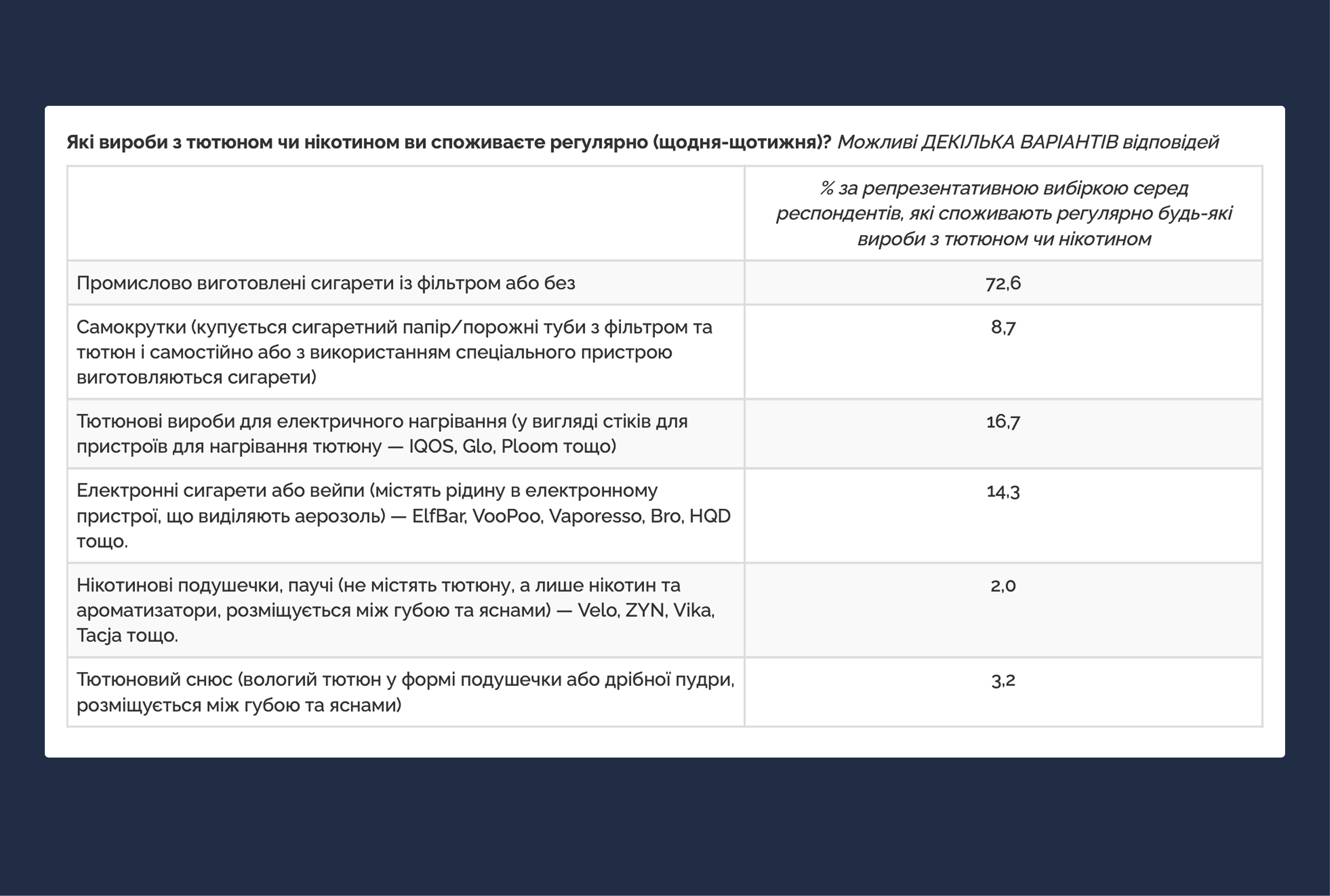
The results of the survey confirm that cigarettes remain the most common product among adult respondents who regularly consume tobacco or nicotine products. Thus, 72.6% of respondents stated that they regularly smoke manufactured cigarettes, 16.7% regularly consume tobacco products for electric heating, 14.3% - electronic cigarettes or vapes, 8.7% - self-rollers, 3.2% - tobacco snus, and 2% - nicotine patches. These data show that traditional cigarette smoking continues to dominate the structure of regular consumption, while alternative categories have a smaller, albeit significant, share.
At the same time, the answers to the question about which product the respondents started their consumption with are even more revealing. The vast majority, namely 86.1%, answered that cigarettes were the first in their experience. For comparison, only 6.2% started with electronic cigarettes, 2.5% - with self-rollers, 1.9% - with hookah, 0.8% - with tobacco products for electric heating, and nicotine pads and tobacco snus were named as the first product by 0.6% of respondents. This structure of answers is important for understanding that for the absolute majority of adult consumers, alternative products did not become a starting category, but most often appeared after a long experience of smoking cigarettes.
A separate block of research was concerned with the reasons why former cigarette smokers switched to alternative nicotine products. The main motivation was the desire to reduce harm to health: this answer was given by 69.3% of respondents, and among users of nicotine pads, this figure is 74.8%. Another significant reason was poor health, particularly coughing or shortness of breath, which was reported by 12.5% of ex-smokers who switched to alternative products and 18.9% of nicotine patch users. Much less often, the decision was related to a doctor's advice or other practical considerations, such as ease of use, smell, price, or the desire to try a different consumption format.
Data on well-being after giving up cigarettes are also important for assessing the behavior of adult users. Among those who used to regularly smoke cigarettes or self-rolling machines, but now do not do so, but regularly consume other nicotine products, 57.2% noted positive changes in their well-being. Respondents primarily talked about easier breathing during physical exertion, less cough and general improvement. Among users of nicotine pouches who previously smoked cigarettes or self-rolling machines, there were even more such users - 68.6%. At the same time, 39.1% in the general group of ex-smokers and 27% among pouch users did not notice changes in their well-being, which is also an important element of the objective picture.
The results related to the consumption of flavored products and the possible consequences of banning non-tobacco flavors deserve special attention. According to the survey, 80.8% of current nicotine patch users use products with flavors other than tobacco. At the same time, if such flavors were banned, only 8.5% of respondents from this group said that they would consider completely giving up tobacco and nicotine products. Instead, 26.8% said they would switch to tobacco flavored pouches, 12.7% would try to find flavored products that would remain available, and 22.5% would switch to other flavored nicotine products. Another 19.2% said that they are already consuming only tobacco flavors. This means that the scenario of complete rejection due to the taste ban is considered only by a small proportion of consumers, while the majority will either adapt their behavior within the same category or shift demand to other product categories.
A similar conclusion can be traced to consumers of tobacco products for electric heating. Among them, 17.8% already use only tobacco flavors, 28.1% would switch to tobacco flavors in case of a ban, 29.8% would try to find non-tobacco flavors, 13.7% would switch to other flavored nicotine products, and only 1.9% said they would completely stop using tobacco and nicotine products. This pattern of responses suggests that bans do not necessarily reduce consumption per se, but may change purchase channels, product categories, or directions of consumer choice.
Another important part of the survey was about which measures citizens consider the most effective for reducing the level of smoking in Ukraine. Most often, respondents mentioned raising the level of awareness of the dangers of smoking in schools, as well as raising the awareness of parents and guardians - this option scored 57.5% as the most effective or second most effective measure. On the second plan, but also quite noticeable, were increased penalties for retailers who sell goods to persons under the age of 18 - 25.7%, as well as the fight against the illegal market of cigarettes and nicotine products - 22.5%. For comparison, only 12.6% of respondents supported the idea of a complete ban on all nicotine-containing products. This gives reason to say that public demand is much more focused on prevention, education, protection of minors and combating illegal trafficking than on total bans.
The answers to the statement that banning some tobacco and nicotine products will not be effective and consumers will simply look for the desired products on the black market are also indicative. 52.9% of respondents completely agreed with this statement, another 33.1% rather agreed. Thus, a total of 86% of respondents expressed the opinion that strict prohibition approaches may not reduce demand, but only stimulate its flow into the illegal segment. In the same context, it is important that 82.2% of respondents completely or somewhat agree that any alternatives that can help adult smokers to quit smoking cigarettes should be available to such consumers.
For VARES, these results are an important reference point in the professional discussion about the future regulation of the market of nicotine-containing products in Ukraine. Survey data show that, according to respondents, effective policies should primarily focus on protecting minors, strengthening sales controls, combating the illegal market, and raising awareness, while bans on certain categories or tastes are not perceived by society as a universal tool to reduce consumption. That's why we continue to share research that helps build an informed, responsible, and evidence-based conversation about public health, consumer behavior, and effective regulation.
**Methodological reference.** The face-to-face survey was conducted in 23 regions of Ukraine and the city of Kyiv, in territories controlled by the government of Ukraine and where hostilities are not taking place. 1031 respondents over the age of 18 were interviewed. The sample is stratified, multi-stage, with random selection at the first stages of formation and quota selection at the final stage according to gender and age parameters. The structure of the sample population reproduces the demographic structure of the adult population of the respective territories as of the beginning of 2022. The theoretical sampling error does not exceed 3.2%, although additional systematic deviations may be associated with the consequences of full-scale war and forced displacement of the population. In addition, 203 respondents who regularly, i.e. daily or weekly, consume nicotine pads were interviewed according to the booster sample.