The electronic cigarette market recorded its highest revenue since 2023
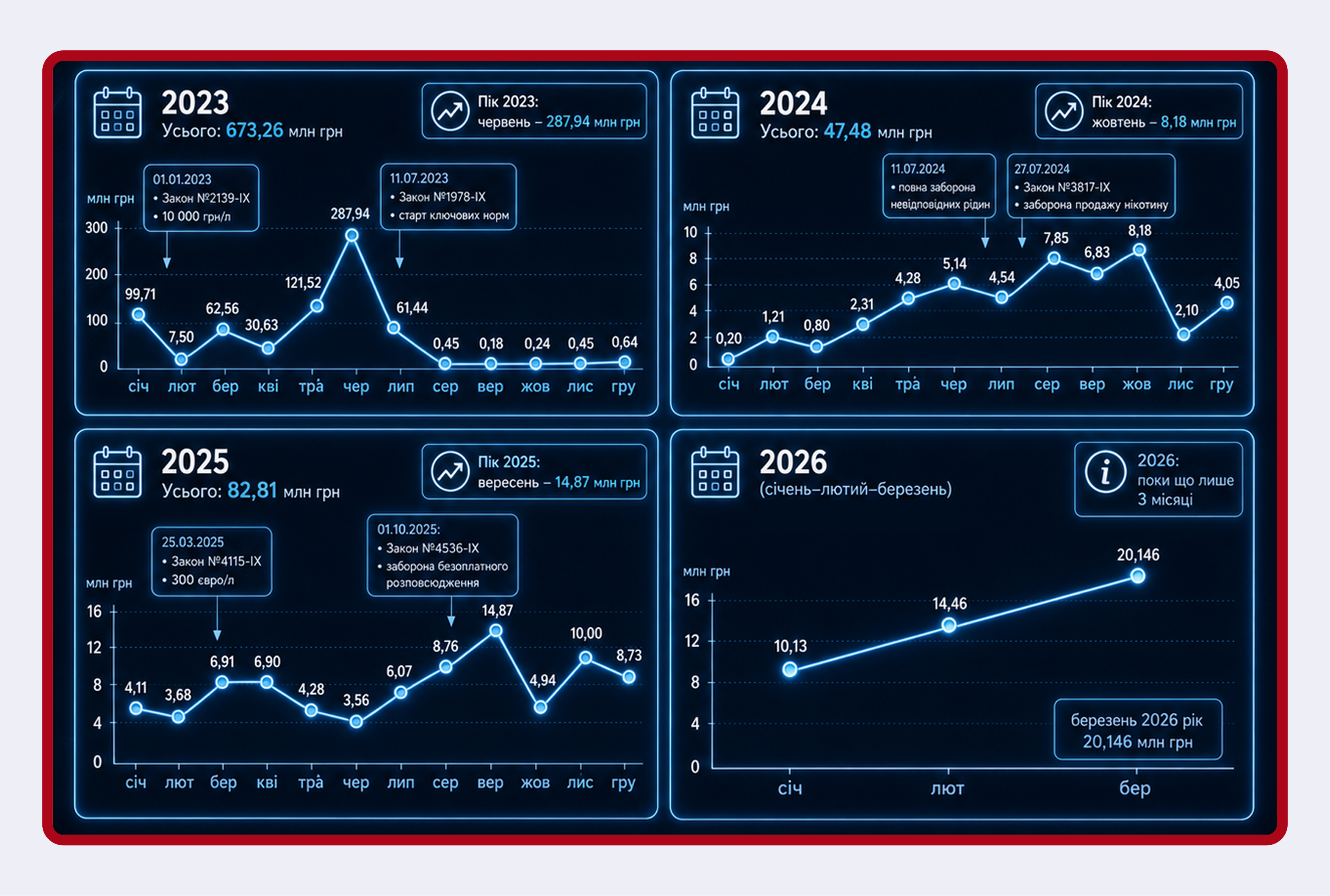
In March 2026, revenues from the electronic cigarette market reached UAH 20.146 million. This is the highest monthly figure since 2023 and an important signal: the legal segment of the market has a significant budget potential if the state creates conditions for transparent work and does not leave demand in the shadows.
The dynamics of the first quarter of 2026 shows a gradual growth: in January, revenues amounted to UAH 10.13 million, in February — to UAH 14.46 million, and in March they already exceeded UAH 20 million. In total, in the first three months of 2026, the budget received UAH 44.73 million.
The comparison with the same month of previous years is especially revealing. In March 2024, the receipts amounted to only 0.80 million hryvnias. This was the period following the launch of the key provisions of Law No. 1978-IX, which included a ban on flavorings, limits on the volume and content of nicotine, and a transition period for the sale of leftovers. The market was actually in a state of regulatory uncertainty, and a significant part of the demand did not enter the legal tax channel.
In March 2025, revenues amounted to UAH 6.91 million. This is more than in 2024, but still significantly below the real market potential. It was in March 2025 that the changes under Law No. 4115-IX entered into force — the transition to an excise tax rate of 300 euros per liter. At the same time, the increase in the rate without comprehensive regulation of the circulation of liquids, nicotine components and retail trade could not completely return the market to the legal field.
March 2026 shows a different trend. Revenues of UAH 20.146 million are almost three times higher than in March 2025 and more than 25 times higher than in March 2024. Moreover, this result is higher than the maximum monthly indicators of 2024 and 2025: in 2024, the peak was UAH 8.18 million in October, and in 2025, it was UAH 14.87 million in September.
This confirms the position of VARES: the problem is not the lack of demand, but the fact that this demand should be directed to the transparent, controlled and taxed legal segment.
VARES also calculated a scenario in which legislative changes are combined with the systematic work of law enforcement and control bodies. In such a model, basic legislative decisions are strengthened by administrative pressure on the illegal segment: legal loopholes are closed, and BEB and other bodies simultaneously destroy illegal sales channels — from underground sales points to the circulation of goods without excise tax stamps.
According to this scenario, revenues may enter the phase of accelerated growth as early as the middle of the year. The calculation is based on the macroeconomic potential of the market: under the condition of full legalization, it is estimated at approximately UAH 322.8 million per month. Even if the shadow share is reduced not to zero, but to a natural minimum of 15–20%, the market may reach a level of about UAH 250 million per month by the end of the year. This is approximately 77% of the full potential of the market, i.e. a mathematically achievable indicator, provided that the legal rules of the game are simultaneously opened and illegal channels are closed.
The state does not need formal prohibitions, but an effective model of regulation that distinguishes legal business from shadowy and gives control bodies real tools for work.
VARES offers:
1. Finalize relevant legislation to finally regulate the sphere of circulation of liquids used in electronic cigarettes and related excise goods. A clear definition of terms and product positions will make it impossible to change concepts, ensure transparent taxation and distinguish between legal and illegal circulation.
2. Establish separate requirements for the nicotine booster: limit its volume to 5 ml, and the mass fraction of nicotine to 120 mg/ml. This will make it possible to obtain a final product with a legally permitted nicotine content of 20 mg/ml.
3. Prohibit the storage of nicotine in places of retail trade of liquids for electronic cigarettes**, if it corresponds to product heading 2939 according to the Ukrainian Tax Code and introduce liability for violations — a fine in the amount of 200% of the value of the product, but not less than UAH 170,000.
4. Distinguish licenses for the right to retail trade in liquids for electronic cigarettes and licenses for the right to retail trade in tobacco products. This will make it possible to form a transparent and identifiable circle of business entities that work specifically with liquids for electronic cigarettes.
The market is already showing that it can give the budget much more. Now the task of the state is to consolidate this dynamic with the right decisions: clear rules, transparent control and a systematic fight against the shadow segment.